

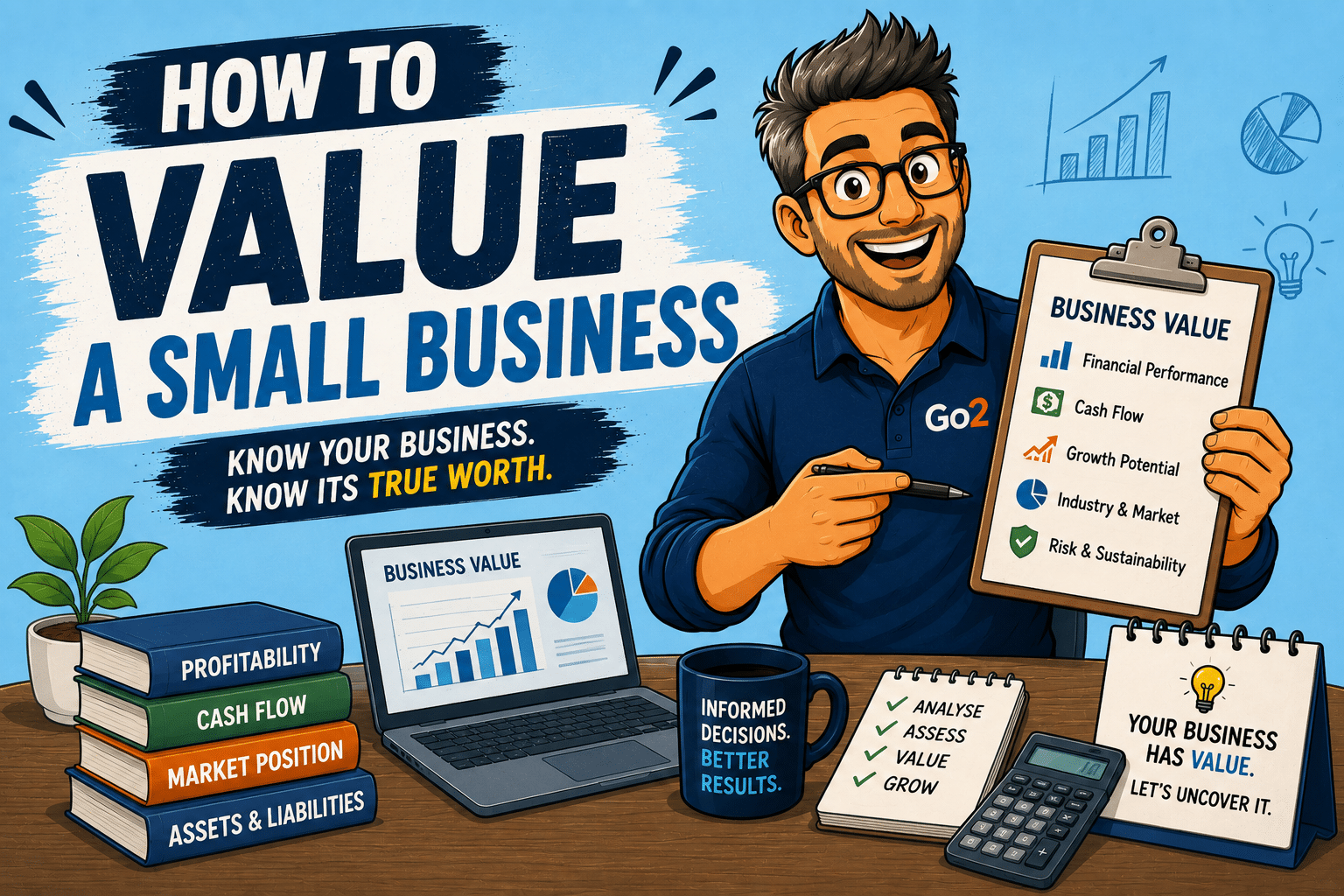
Whether you’re thinking of selling, buying, bringing in a partner, or just curious what you’ve built, one question eventually surfaces:
“What is my business actually worth?” 🤔
It’s a deceptively tricky question — because a business isn’t worth what you think it is, what you’ve put into it, or even what it earns. It’s worth what someone will pay for it, and valuation is the art (and science) of estimating that number credibly.
Here’s how business valuation works in South Africa, in plain language.
⚠️ This is general information, not a formal valuation or financial advice — a real valuation needs your actual numbers reviewed by a professional.
💡 First: why “what I put in” isn’t the value
A hard truth for many owners: the years of sweat, the capital you invested, the late nights — none of that directly sets the price 😅
A buyer isn’t paying for your effort. They’re paying for the future profit and cash flow the business will generate for them. That mindset shift — from “what it cost me” to “what it will earn them” — is the foundation of every valuation method below.
📊 The main ways to value a small business
There’s no single “correct” number — different methods suit different businesses, and a good valuation often triangulates several:
💰 Earnings multiple — the most common for profitable small businesses. You take a normalised profit figure (often EBITDA — earnings before interest, tax, depreciation and amortisation) and multiply it by an industry-appropriate multiple. A business earning R1m with a multiple of 3 is worth roughly R3m — but the multiple is everything, and it varies hugely by industry, risk and growth.
📈 Discounted cash flow (DCF) — projects the future cash the business will generate and discounts it back to today’s value. More sophisticated, better for businesses with predictable cash flows, but very sensitive to assumptions.
🏦 Asset-based — the net value of assets minus liabilities. Suits asset-heavy businesses (property, equipment) or ones being wound down, but ignores the value of a profitable going concern.
🔁 Market comparison — what similar businesses in your sector have actually sold for. Useful sanity-check, if comparable data exists.
❓ What drives my business’s value up or down?
Two businesses with identical profits can be worth very different amounts. What moves the needle:
⬆️ Increases value: recurring/predictable revenue, a diverse customer base, low reliance on the owner, clean financial records, growth trend, strong systems and staff
⬇️ Decreases value: heavy dependence on you personally, one or two clients making up most of revenue, messy books, declining sales, no documented processes
That single factor — owner-dependence — is the big one for small businesses. If the business is you, a buyer is buying a job, not an asset, and they’ll pay far less 🔑
❓ Why do clean financials matter so much for valuation?
Because buyers pay for certainty, and messy books scream risk 📉
When your numbers are accurate, up to date and professionally prepared — ideally with a few years of solid management accounts and annual financial statements behind them — a buyer can trust the profit figure the whole valuation rests on. When they’re a shoebox of guesses, buyers discount heavily to protect themselves, or walk away.
In other words: good financial hygiene doesn’t just keep SARS happy — it literally makes your business worth more 💰
❓ When should I get a business valuation?
Common triggers:
🤝 Selling the business or buying another 👥 Bringing in a shareholder or buying one out 💼 Raising investment or finance 📋 Structuring for succession, divorce, or estate planning 📈 Simply benchmarking — knowing your number so you can grow it deliberately
Even if you’re years from selling, knowing your valuation now tells you which levers to pull to increase it — a genuinely useful strategic exercise.
🎯 Know your number — then grow it
A business valuation isn’t just a price tag; it’s a mirror. It shows you exactly where your business is strong and where it’s fragile — and gives you a target to build toward.
The team at Go2 Accounting helps South African business owners understand what their business is worth, how to value a small business, prepare the clean financials a credible valuation needs, and structure the business to be worth more when it counts. It’s part of what our outsourced CFO service is built for.
Because you can’t grow the value of something you’ve never measured 😉





Leave A Comment