
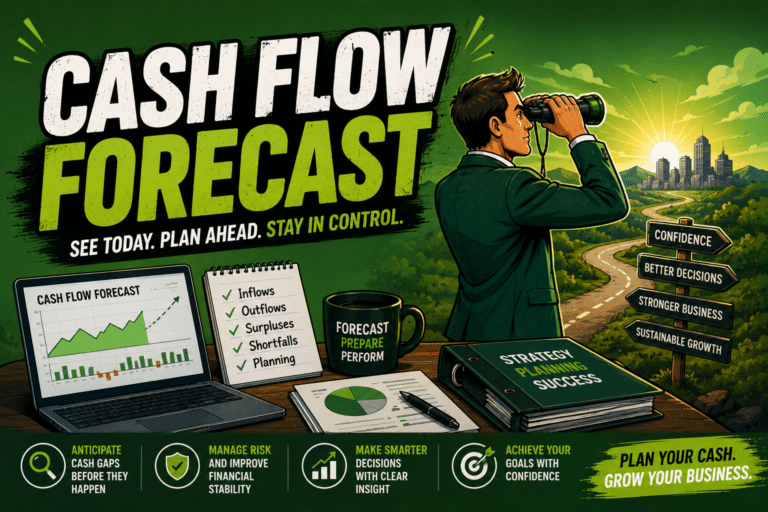
Here’s one of the cruellest truths in business: you can be profitable and still go broke 😵
It sounds impossible, but it happens all the time. A business lands big orders, shows a healthy profit on paper… and then can’t make payroll because the cash hasn’t arrived yet. Profit is an opinion. Cash is a fact. A cash flow forecast helps you stay on top of the facts. ⭐
💸 Why profitable businesses run out of cash
Profit and cash are not the same thing, and confusing them sinks businesses. Here’s how a profitable company hits a wall:
⏳ You invoice R500,000 but clients pay in 60 days — the profit is “earned” but the cash isn’t in 📦 You buy stock now and sell it in three months — cash out long before cash in 💼 You hire ahead of growth — salaries hit immediately, the revenue lags 🏦 A big tax or VAT payment lands the same week as payroll
On the income statement, everything looks great. In the bank account, it’s a crisis. That gap is where businesses die 😬
📊 What is a cash flow forecast?
A cash flow forecast is a simple forward-looking projection of the money coming in and going out of your business over the weeks and months ahead.
At its heart it answers one priceless question: “Will I have enough money in the bank to cover what’s coming?” 🎯
A basic forecast maps out:
To make it more active and readable, rewrite it like this:
- 💰 Expected income — when customers are likely to pay you (not just when you issue the invoice)
- 📤 Expected outgoings — pay salaries, rent, suppliers, loan repayments and tax
- 📅 Timing — the most important factor, because cash flow depends on when money moves, not just how much
❓ How far ahead should I forecast?
For most small businesses, a rolling 13-week (one quarter) forecast is the sweet spot for day-to-day cash management — near enough to be accurate, far enough to give you warning.
Pair that with a longer 12-month view for bigger-picture planning (tax payments, growth, seasonal dips), and you’ve got both the short game and the long game covered 📆
❓ How do I actually build a cash flow forecast?
The basic steps:
1️⃣ Start with your current bank balance
2️⃣ List all expected income by the week/month you’ll actually receive it
3️⃣ List all expected outgoings by when they’ll actually leave
4️⃣ Calculate your running balance forward
5️⃣ Look for the danger points — weeks where the balance dips low or negative
6️⃣ Act early on those danger points, while you still have options 💡
The magic isn’t the spreadsheet — it’s the early warning. Spotting a squeeze eight weeks out means you can chase debtors, delay a purchase or arrange finance calmly. Spotting it on the day is a panic.
❓ Can cloud accounting help with cash flow forecasting?
Massively. When your cloud accounting system already knows your outstanding invoices, recurring bills and payment patterns, building and updating a forecast becomes far quicker and more accurate — many platforms and add-ons do a lot of it automatically.
Combined with monthly management accounts, a live forecast is one of the most powerful tools a small business can have — and a core part of what an outsourced CFO manages for you.
🎯 Never be surprised by your own bank balance again
Cash flow forecasting isn’t about complicated finance — it’s about seeing trouble (and opportunity) before it arrives. It’s the single most practical habit that separates calm, in-control business owners from the ones lurching from one cash scare to the next.
The team at Go2 Accounting helps South African businesses build and maintain cash flow forecasts that turn financial anxiety into financial control.
Because running out of cash is rarely a money problem — it’s usually a planning problem 😉
