


So you’ve decided to make it official and register a company 🎉
Good news: it’s faster and simpler than most people fear. The process is now largely online, takes just a few business days, and requires no stack of paperwork or lawyer.
Here’s the honest, step-by-step guide.
⚠️ Fees and processes can change, always confirm current details on the official CIPC website (cipc.co.za) or BizPortal before paying anyone.
🏛️ First: what does registering do (and which entity)?
Registering with the CIPC (Companies and Intellectual Property Commission) creates a legal entity separate from you, which lets you open a business bank account, apply for tenders, sign contracts, and protect your personal assets from business liabilities.
For most small businesses, the entity you want is a Private Company (Pty) Ltd. (Close Corporations can no longer be registered, existing ones still operate, but new CCs aren’t an option.) A Pty Ltd needs at least one director and one shareholder, which can be the same person, so yes, you can register a company on your own 👍
💳 What it costs
Registering a company through CIPC involves a modest official registration fee, with an optional extra if you choose to reserve a specific name rather than trading under your registration number, and a further optional cost if you need a custom MOI (most small businesses don’t).
Beyond the CIPC fees themselves, most business owners choose to have a professional handle the registration for them, preparing the documents correctly, avoiding rejections and delays, and bundling in the SARS and related registrations so the company is properly set up from day one. It’s the difference between a DIY afternoon on the portal and a done-for-you company that’s ready to trade 💡
✅ Step 1: Choose your registration route
Companies are registered via CIPC eServices (eservices.cipc.co.za) or BizPortal (bizportal.gov.za), both of which work on a pre-paid account system. BizPortal is often the smoother route for SA ID holders — it’s simpler and can bundle in your business bank account and some SARS registrations 🚀
This is also the point where many owners decide to hand the process over to their accountant instead — the requirements below are the same either way, but a professional absorbs the admin, the account top-ups and the risk of rejection.
✅ Step 2: Reserve your name (or skip it)
You can reserve up to four proposed names in order of preference. Tips to avoid the most common delay — name rejection:
🔍 Search the CIPC database first — names too similar to existing ones get rejected ✨ Add a distinctive element (generic names like “ABC Trading” are frequently declined) 🚫 Avoid restricted words like “bank” or “university” (they need special approval)
Prefer speed over branding? Skip the name entirely, CIPC will assign your registration number as the name (e.g. “2026/123456/07 South Africa”), and you can add a trading name or reserve a proper name later.
✅ Step 3: File the registration
Complete the registration (the CoR14.1 and related forms), providing:
👥 Director and shareholder details and ID numbers 🏠 A physical South African registered address (no PO boxes) 📄 Certified ID copies where required
With BizPortal you can often sign digitally; via eServices you may need to sign, scan and upload the forms.
✅ Step 4: Receive your registration certificate
Once approved — typically within a few business days — CIPC issues your CoR14.3 registration certificate and unique registration number. That’s your company’s “birth certificate” 🎉
❓ What must I do after registering? (The part people forget)
Registration is the start, not the finish. Your post-registration checklist:
🏦 Open a business bank account — take your CoR14.3 and director IDs to any major bank
🧾 Register for tax with SARS — CIPC registration often triggers automatic income tax registration, but confirm it and get your tax number
📊 Register for VAT — only if/when required (see our VAT registration guide)
👨💼 Register for PAYE & UIF — if you’ll have employees
📋 Diarise your CIPC annual return — every year on your registration anniversary, or you risk penalties and eventual deregistration
🎯 Get a B-BBEE affidavit — small businesses under the threshold can often get a free affidavit, useful for tenders
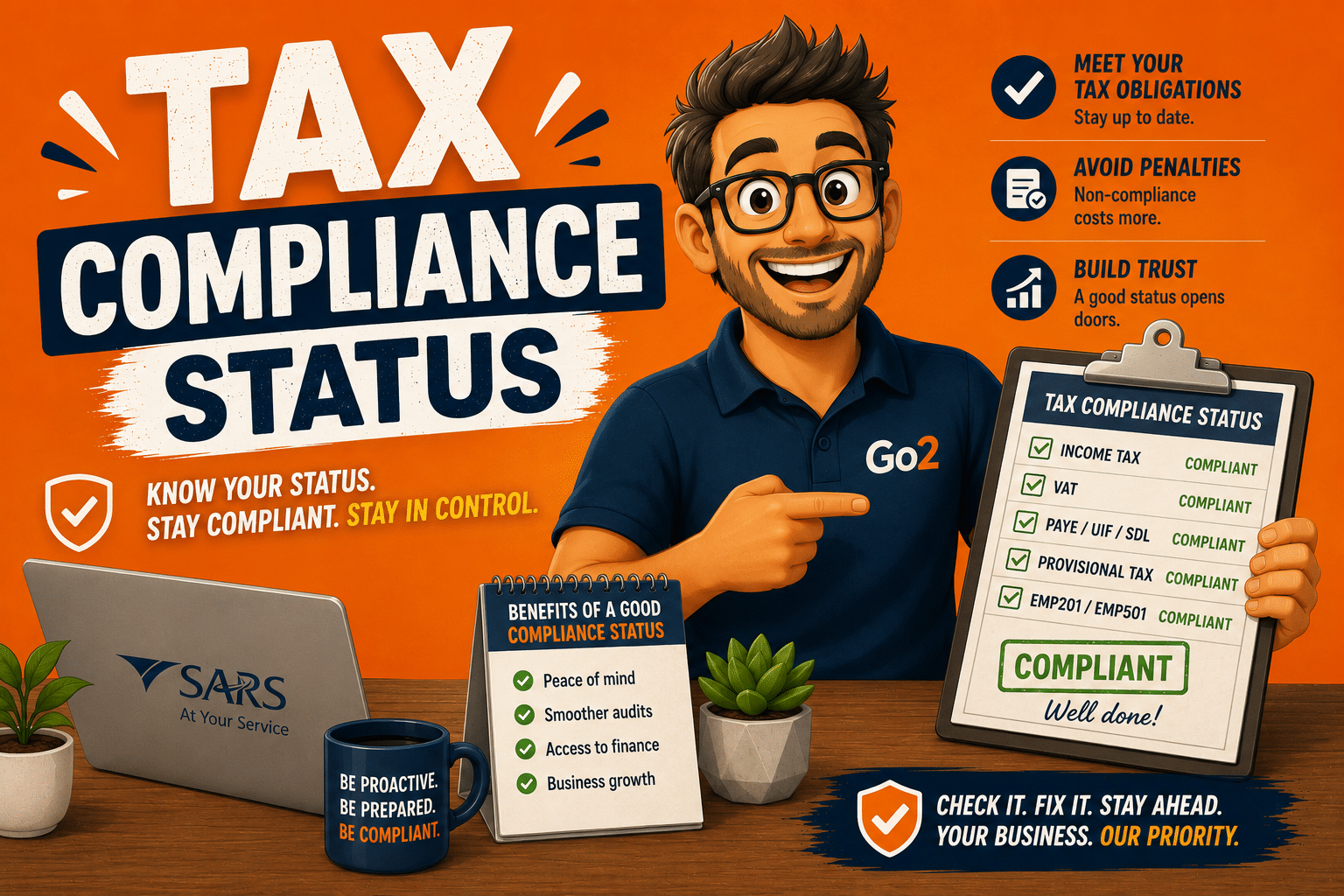
⚠️ Crucially: registering with CIPC does not automatically make you tax-compliant or handle your bookkeeping. Those are separate, ongoing responsibilities.
🎯 Registered — now build it properly
Getting the company registered is the easy 10%. The 90% that determines whether it thrives is what comes next: clean books, tax compliance, and smart financial decisions from day one.
The team at Go2 Accounting helps new South African businesses get set up correctly from the start. Go2 helps with company registration, SARS registrations, and the cloud accounting foundation to keep it all compliant.
Because registering a company is a moment, running one well is the real work 😉









Leave A Comment