
It’s one of the most common questions small business owners ask — usually right after their business starts making enough money to need someone:
“Do I need a bookkeeper or an accountant? And… aren’t they the same thing?” 🤔
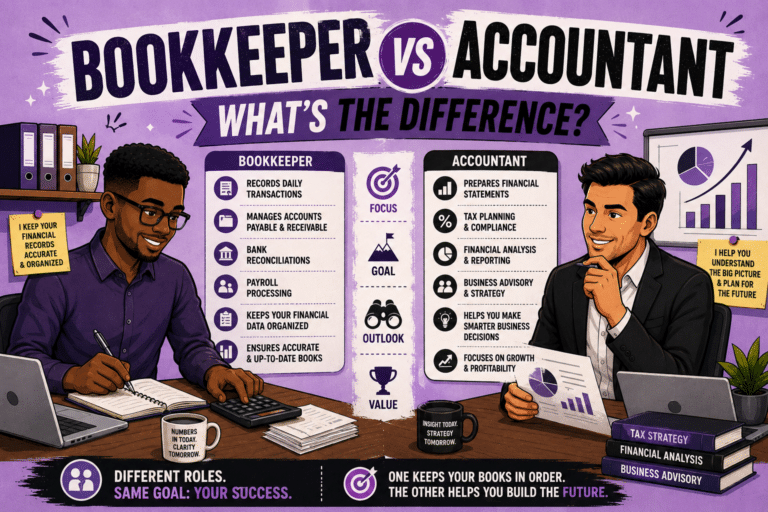
Short answer: no, they’re not the same but they work as a team. Think of it like building a house: the bookkeeper lays the bricks, day by day. The accountant is the architect who designs the structure, makes sure it’s sound, and signs off the plans 🏗️
Here’s exactly what each one does, and which your business needs right now.
🧱 What does a bookkeeper do?
A bookkeeper handles the daily financial record-keeping, the foundation everything else is built on:
📥 Recording income and expenses
🏦 Reconciling bank accounts
🧾 Capturing invoices and receipts
💳 Tracking who owes you (debtors) and who you owe (creditors)
💼 Often processing payroll and basic VAT
In short, bookkeepers keep your financial data accurate, organised and up to date. Without good bookkeeping, everything downstream tax, reporting, decisions — is built on sand 🏖️
🎓 What does an accountant do?
An accountant takes that organised data and turns it into insight, compliance and strategy:
📊 Preparing annual financial statements
🧮 Calculating and submitting tax returns (income tax, provisional tax, company tax)
✅ Ensuring SARS and CIPC compliance
📈 Interpreting your numbers profitability, cash flow, growth
🧠 Tax planning and business advice
⚖️ Representing you in SARS disputes and audits
A registered tax practitioner or qualified accountant can do things a bookkeeper legally can’t, like submitting tax returns as your authorised representative and signing off statements.
🆚 The key difference in one line
Bookkeeping is about recording what happened. Accounting is about interpreting it, complying with the law, and planning what happens next.
One looks backwards to keep the record straight. The other looks forwards to keep you compliant and growing 🔭
❓ Do I need a bookkeeper or an accountant?
Here’s the honest guide based on where your business is:
🌱 Just starting / very small — you may only need an accountant once a year for tax, and do basic bookkeeping yourself (cloud software makes this easier than ever)
📈 Growing, with regular transactions — you’ll want ongoing bookkeeping (monthly) plus an accountant for tax and compliance
🏢 Established with staff, VAT and complexity — you need both working together: a bookkeeper (or bookkeeping service) keeping monthly records, and an accountant handling compliance, reporting and strategy
The good news? You don’t have to hire two separate people. Many firms, including ours provide both functions under one roof, so your books and your tax talk to each other seamlessly 🤝
❓ Can one person do both?
Often, yes especially in a firm setup. A qualified accountant can absolutely do bookkeeping, and many smaller practices handle the whole chain from daily capturing to annual tax.
What you want to avoid is the reverse: relying on a bookkeeper alone for things that need an accountant’s qualification and SARS registration like signing off financial statements or handling a tax dispute. That’s where unqualified “I do books and tax” operators get business owners into trouble 🚩
❓ Is a bookkeeper cheaper than an accountant?
Generally yes bookkeeping is charged at a lower rate than accounting and tax work, because it’s more routine. That’s exactly why the smart structure is to have routine work done at bookkeeping level and high-skill work done at accountant level you’re not overpaying for data capture, or underpaying for compliance.
Modern cloud accounting blurs the line helpfully: automation handles much of the bookkeeping grunt-work, freeing your accountant to focus on the valuable stuff.
🎯 The bottom line
You don’t have to choose between a bookkeeper and an accountant most growing businesses need both functions, just at different intensities. The trick is matching the right level of skill (and cost) to each task.
At Go2 Accounting, we provide the full chain under one roof from day-to-day bookkeeping to accountant-level tax, compliance and advice so nothing falls through the cracks between “the books” and “the tax.”
Because accurate books and smart accounting aren’t competitors they’re teammates 😉
