
“Why me?” 😩
It’s the first thing every taxpayer asks when that dreaded SARS audit notification lands.
And here’s the uncomfortable answer: it’s probably not bad luck.
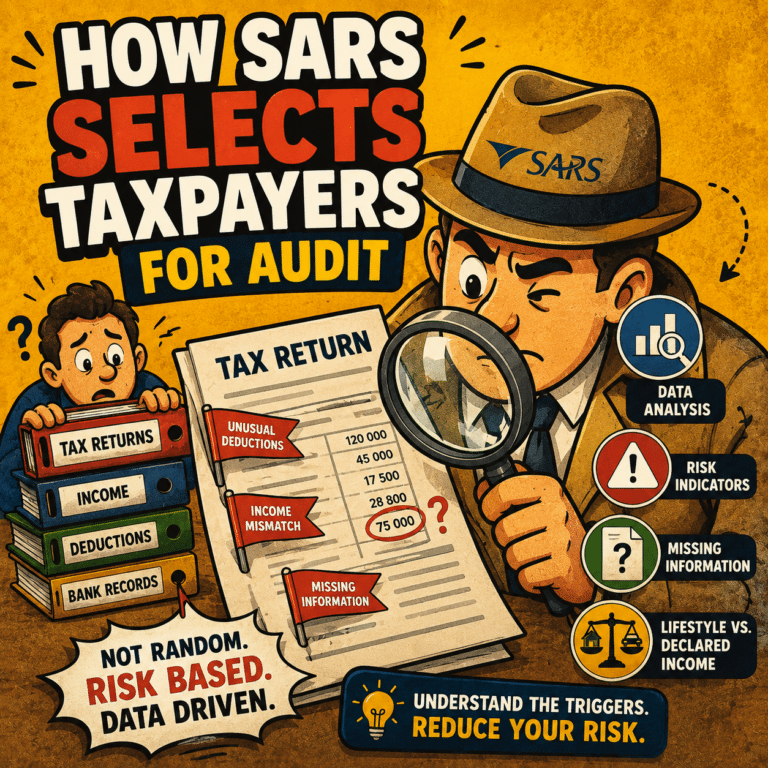
Today’s SARS runs on data, algorithms and artificial intelligence. A SARS audit in 2026 is less “name out of a hat” and more “the computer flagged you three months ago and has been quietly building a file” 🤖
So how does SARS actually decide who gets audited? Let’s pull back the curtain.
🚨 The risk engine never sleeps
Every return you submit gets run through SARS’s automated risk engine.
It compares what you declared against what everyone else says about you:
🏦 Your bank’s reports 💼 Your employer’s IRP5 submissions 🏥 Your medical aid’s records 📈 Your investment and crypto platform data 🏠 Property transfer records from the Deeds Office
Translation?
SARS often knows your financial story before you’ve even logged in to eFiling. If your version doesn’t match theirs, the system raises its hand 🙋
🔍 The most common SARS audit triggers
These are the red flags that get returns pulled for a closer look:
⚠️ Mismatched numbers — your declared income doesn’t match third-party data 💸 Unusually large deductions — home office, travel or medical claims far above the norm for your income bracket 📉 Lifestyle vs income gaps — luxury cars and overseas trips on a modest declared income (yes, lifestyle audits are real) 🔁 Repeated refunds — a refund every single year starts to look like a pattern 🏢 Industry benchmarks — your business margins differ wildly from others in your sector 🕳️ Non-submission — outstanding returns practically wave a flag at SARS 🎲 Random selection — a small percentage is still drawn randomly to keep everyone honest
❓ What is the difference between a SARS audit and a verification?
Great question — they’re often confused.
A SARS verification is a document check: SARS asks you to upload proof (invoices, logbooks, certificates) to confirm what you declared. It’s usually resolved in weeks.
A SARS audit goes deeper. SARS examines your financial records, bank statements and business affairs in detail — and it can stretch over months. An audit can also look back at previous tax years 📂
Verification is a spot check. An audit is an investigation.
❓ How will I know if SARS is auditing me?
SARS must formally notify you, usually via eFiling and your registered email.
The notification will state the scope of the audit and which tax years are involved.
🚩 Important: if someone phones you out of the blue claiming to be a “SARS auditor” demanding payment, that’s not an audit — that’s a SARS scam. Real audits arrive in writing, on your eFiling profile.
❓ How do I avoid a SARS audit?
You can’t make yourself audit-proof, but you can make yourself boring to the algorithm (in the best way):
✅ Declare all income — SARS probably already knows about it ✅ Keep your deductions honest and your documents ready ✅ File and pay on time, every time — see our SARS tax dates guide ✅ Make sure your lifestyle and your declared income tell the same story ✅ Respond to SARS queries quickly and completely
Boring taxpayers don’t get flagged. Be gloriously boring 😴
🎯 Flagged for audit? Don’t panic — prepare
A SARS audit isn’t an accusation, but it is serious. The taxpayers who come out unscathed are the ones with clean records, complete documents and professional guidance from day one.
If you’ve received an audit notification — or you’d like your affairs reviewed before SARS does it for you — the team at Go2 Accounting is ready to help.
Because the best time to prepare for a SARS audit is before SARS knows your name 😉
