
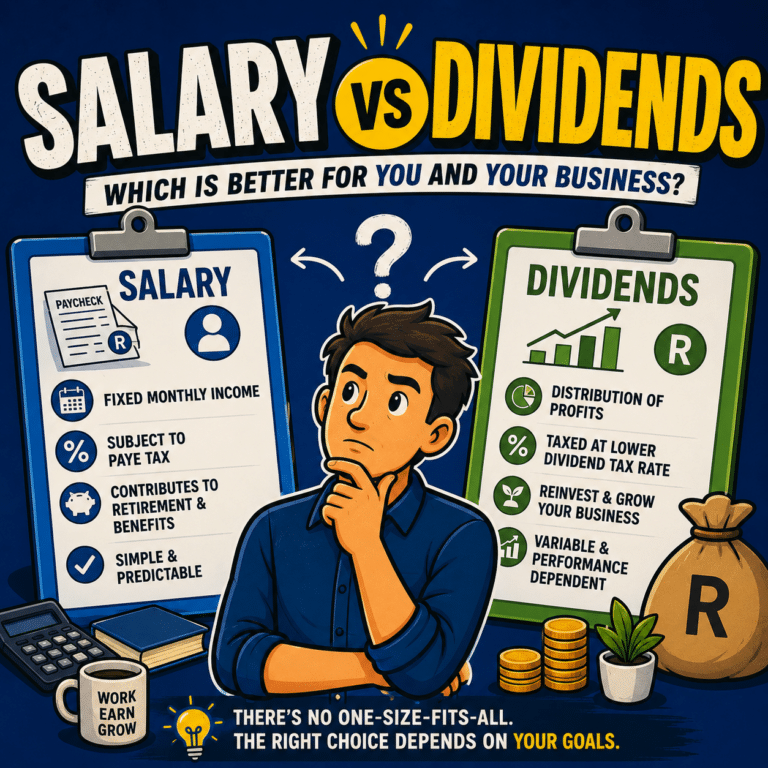
You started a company, it’s finally making money, and now you face the question every business owner eventually Googles at 11pm:
“How do I actually pay myself — salary or dividends?” 🤔
It’s one of the most important tax questions you’ll ever ask, because the wrong answer can cost you thousands in unnecessary tax every year. The right answer can legally keep more money in your pocket.
Let’s break it down — South African rules, plain language.
⚠️ Quick disclaimer: this is general information, not personal tax advice. The optimal split depends on your numbers — please get it tailored before acting.
💰 Option 1: Pay yourself a salary
A salary (or director’s remuneration) is a deductible expense for your company — it reduces the company’s taxable profit. But in your hands it’s subject to PAYE on the normal individual sliding scale, plus UIF.
The upside:
✅ Reduces company profit (and therefore company tax) ✅ Counts as income for bonds, finance and credit applications 🏦 ✅ Builds your retirement annuity contribution room ✅ Predictable, monthly, simple
The downside: at higher income levels, the individual tax rate climbs above the company rate — so paying everything as salary can be inefficient.
📈 Option 2: Pay yourself dividends
Dividends are paid out of company profit after the company has paid its 27% company tax. The dividend itself then attracts Dividends Tax of 20%.
The upside:
✅ No PAYE, no UIF ✅ Simple to declare ✅ Flexible timing — pay when profits and cash allow
The downside:
❌ Not deductible for the company (it’s paid from after-tax profit) ❌ The combined effect of company tax + dividends tax means dividends aren’t automatically “cheaper” than salary ❌ Doesn’t build RA room or show as income for finance applications
🧮 So which is actually cheaper?
Here’s the part most people get wrong: it’s not simply “dividends win” or “salary wins.”
When you stack 27% company tax and then 20% dividends tax, the effective combined rate on dividends is meaningful — often landing in a similar zone to a higher individual tax bracket. Meanwhile, salary is taxed once, on the sliding scale, and reduces company tax along the way.
Translation? For many owner-managed companies, the smartest answer is a blend — and that’s where real tax planning earns its fee 🎯
❓ What is the most tax-efficient way to pay yourself?
For a lot of small business owners, the efficient structure looks something like:
1️⃣ A salary up to a sensible level — using lower tax brackets, building RA room, and reducing company profit
2️⃣ Topping up with dividends from remaining profit
3️⃣ Considering other tools — RA contributions, medical credits, and whether you qualify as a Small Business Corporation with its reduced rates
The exact split depends on your profit, your other income, and your goals (buying a house soon? building retirement savings?). There’s no universal answer — only an optimal one for your numbers 📊
❓ Do I have to pay myself a salary if I’m a director?
Not strictly — but be careful. Paying yourself only dividends and zero salary can raise questions, limits your RA contributions, and leaves you with no “income” on paper when you apply for a bond.
There’s also a SARS-awareness angle: artificial structures designed purely to dodge PAYE attract scrutiny. Keep it commercially sensible 🚩
❓ What about provisional tax?
Important one. If you earn dividends or other non-salary income, you likely become a provisional taxpayer — meaning you must estimate and pay tax twice a year, not just via monthly PAYE.
Get this wrong and you’re facing underestimation penalties. We’ve covered the essentials in our provisional tax guide ⏰
🎯 Get the split right — it’s worth real money
Salary vs dividends isn’t a one-time decision you Google once. It’s an annual optimisation that should flex with your profit, your tax bracket and your life plans. Done well, it’s one of the highest-return hours of tax planning a business owner can invest in.
The team at Go2 Accounting helps owner-managed businesses structure the most tax-efficient, SARS-compliant way to pay themselves — and reviews it every year as your business grows.
Because how you pay yourself matters almost as much as how much you make 😉
