

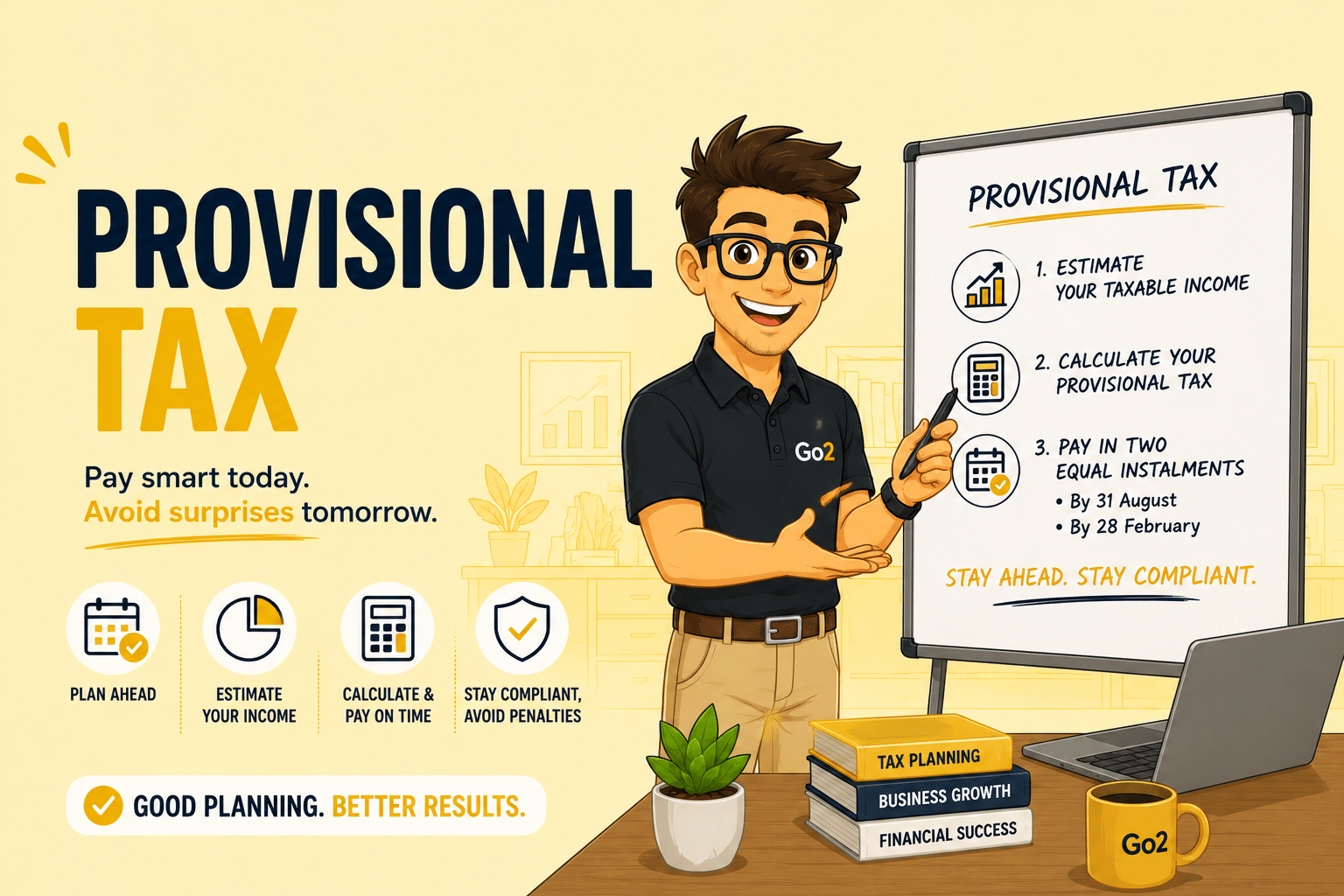
Few tax terms cause as much confusion, and as many unexpected penalties, as “provisional tax” 😅
If you’ve recently started earning income outside a salary and someone mentioned you’re now a “provisional taxpayer,” you probably have questions. What is it? Do I owe extra tax? When are the deadlines? And why does everyone warn about penalties?
Let’s clear it all up in plain language.
⚠️ This is general information, not personal tax advice, your provisional tax position depends on your circumstances, so confirm yours with SARS or your accountant.
📆 What is provisional tax?
First, the myth-buster: provisional tax is not an extra tax. It’s simply a way of paying your normal income tax in advance, in instalments during the year, rather than in one big lump at year-end 💡
The idea is sensible: if your income isn’t taxed monthly through PAYE (like a salary is), SARS would otherwise wait until year-end for its money, and you’d face one enormous bill. Provisional tax spreads that liability across the year, based on your estimated income, so there’s no nasty year-end surprise.
At assessment, your provisional payments are offset against your actual tax bill, you top up any shortfall or get any overpayment refunded.
❓ Am I a provisional taxpayer?
This is the question that catches people out. Broadly, you’re a provisional taxpayer if you earn income that isn’t fully taxed through PAYE. That includes:
💼 Sole proprietors and freelancers
🏢 Company directors and members earning non-salary income
🏘️ People with significant rental income
📈 People with substantial investment income (interest, dividends)
🏗️ Anyone running a business in their own name
Companies and trusts are automatically provisional taxpayers. Most pure salary-earners with no other income are not. SARS puts the onus on you to work out whether you’re liable — so if you’re unsure, check, because “I didn’t know” doesn’t waive the penalties 😬
🗓️ Provisional tax deadlines
For taxpayers with the standard 1 March–end February tax year, there are two compulsory payments, plus an optional third:
First payment — end of August (halfway through the tax year), based on estimated income for the year
Second payment — end of February (year-end), based on a refined full-year estimate
Third (optional) top-up — around September, to top up any shortfall before final assessment and reduce interest/penalties
Each payment is made by submitting an IRP6 return on eFiling. If a deadline falls on a weekend or public holiday, pay by the last working day before 📆
⚠️ The penalties everyone warns about
Provisional tax has two distinct penalty traps, and they catch people every year:
💸 Late payment penalty — miss a payment deadline and SARS levies a 10% penalty, plus interest until it’s paid.
📉 Underestimation penalty — this is the sneaky one. Your second (February) estimate has to be reasonably accurate. If your estimate is too low compared to your actual assessed income, SARS charges a 20% underestimation penalty on the shortfall:
- If your taxable income is R1 million or less: your estimate should be at least 90% of actual (or meet the “basic amount” from your last assessment)
- If your taxable income is above R1 million: your estimate must be at least 80% of actual
In short: pay on time, and estimate accurately. Getting one right but not the other still costs you 🚩
💡 A helpful 2026 update
There’s some good news for 2026: from 1 March 2026, the threshold for relying on your historical assessed income (the “basic amount”) when estimating increased from R1 million to R1.8 million — which can reduce the underestimation-penalty risk for a band of taxpayers. Worth knowing if your income sits in that range 📈
❓ How do I estimate my income accurately?
This is the heart of provisional tax, and where a good accountant earns their fee. A solid estimate means projecting your full-year taxable income realistically, not too low (penalties) and not wildly too high (you overpay and wait for a refund). With good cloud accounting such as Xero and current numbers, that projection becomes far more accurate than a year-end guess. Lumpy or unpredictable income makes this harder, which is exactly when professional help pays off 🎯
❓ What if I can’t afford my provisional tax payment?
Don’t simply skip it, that triggers penalties and interest. If cash flow is tight, options include arranging your affairs to pay on time, or engaging SARS about a payment arrangement if you’re genuinely unable to pay. Silence is always the most expensive choice with SARS.
🎯 Take the surprise out of provisional tax
Provisional tax isn’t complicated once you understand it, it’s just your normal tax, paid in advance, with two golden rules: pay on time, and estimate accurately. Get those right and it’s painless. Get them wrong and the penalties add up fast.
Go2 Accounting handles provisional tax for individuals and businesses across Pretoria and Centurion, accurate estimates, IRP6 submissions and deadline management, so you never face a penalty surprise. Get in touch for a no-obligation chat.
Because provisional tax should spread your tax bill, not multiply it with penalties 😉








Leave A Comment