
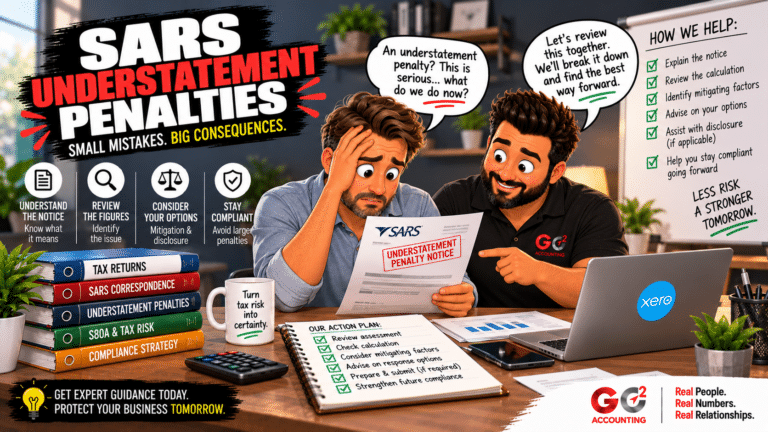
Most people think a tax mistake just means paying what you owe plus a bit of interest. The reality can be far more brutal 🚨
Under the Tax Administration Act, SARS can hit you with an understatement penalty ranging from 10% to a staggering 200% of your tax shortfall, and in 2026, SARS has been tightening how these are applied. The penalty you get depends almost entirely on how the understatement happened. Here’s how the system works, and how to stay out of its crosshairs.
🚨 What is an understatement penalty?
An “understatement” is broadly any prejudice to SARS caused by failing to submit a return, omitting something from a return, making an incorrect statement, or not paying tax that’s due. When SARS finds one, usually after a verification or audit, it applies a penalty calculated as a percentage of the tax shortfall (the difference between what you declared and what you actually owed).
The percentage isn’t random. It’s set by a table in the Act, based on your behaviour 📊
📋 The understatement penalty table, behaviour decides everything
This is the heart of it. SARS classifies the behaviour behind the understatement into categories, each with a “standard case” rate and a higher rate for obstructive or repeat cases:
🟢 Substantial understatement — 10% (standard) / 20% (repeat or obstructive)
🟡 Reasonable care not taken — 25% (standard)
🟠 No reasonable grounds for the tax position taken — 50% (standard)
🔴 Gross negligence — 100% (standard)
⚫ Intentional tax evasion — 150% (standard) / up to 200% (repeat or obstructive)
The difference between an honest-but-careless slip (25%) and something SARS views as deliberate (up to 200%) is enormous, on the same shortfall. Behaviour is everything 🎯
❓ What is a “substantial understatement”?
This is the lowest-culpability category (10%), and it applies where the prejudice to SARS exceeds the greater of 5% of the tax properly chargeable, or R1 million, regardless of whether you were careless or not. In other words, a big enough understatement attracts a penalty even if you genuinely did your best. The silver lining: it carries the lowest rate, and can even be remitted in certain cases 💡
❓ Can an understatement penalty be reduced or waived?
Yes, in specific circumstances:
🔍Voluntary disclosure — if you come forward and disclose before SARS starts an audit or investigation, the penalty can drop dramatically (even to 0% for a substantial understatement). Honesty, early, pays.
💡Bona fide inadvertent error — a genuine, innocent mistake may fall outside the penalty regime entirely.
⚖️Remittance for substantial understatement — SARS must remit this penalty in certain qualifying cases (for example, where you were correctly registered and filed on time with a reasonable position).
The common thread: the earlier and more transparent you are, the better your position 🤝
❓ How do I avoid understatement penalties altogether?
The best defense is simple, if not always easy:
🎯Declare accurately and completely — match the third-party data SARS already holds
🗂️Keep proper records for five years, so you can support every position
🔎Take reasonable care — the “reasonable care not taken” category (25%) catches avoidable sloppiness
💡Get professional advice on grey areas — a defensible tax position protects you from the “no reasonable grounds” penalty
🚨Disclose early if you spot your own error, before SARS does
In a data-driven, compliance-tight SARS environment, accuracy isn’t just good practice, it’s financial self-defense.
🎯 Don’t let behaviour turn a mistake into a disaster
The scary thing about understatement penalties isn’t the 10%, it’s how fast the percentage climbs when SARS judges your behaviour harshly. The same shortfall can cost you a little or a fortune, depending entirely on how it happened and how you respond.
Go2 Accounting helps businesses and individuals across Pretoria and Tshwane file accurately, maintain defensible records, and respond correctly if SARS raises a penalty, keeping you firmly in the low-risk categories. Get in touch for a no-obligation chat.
Because with SARS penalties, how you got it wrong matters as much as the mistake itself 😉
