
Which Does Your Company Actually Need?
Here’s a question that trips up a surprising number of company directors: does my business legally need an audit, or just an independent review, and what’s the difference anyway? 🤔
Get it wrong in one direction and you’re paying for an expensive audit you never needed. Get it wrong in the other and you’re non-compliant with the Companies Act. Neither is where you want to be.
So let’s clear it up. Here’s independent review vs audit, what each is, and how to tell which one applies to your company.
📊 First, what’s the actual difference?
Both are independent checks on your company’s financial statements, but they’re very different in depth, cost and who performs them 👇
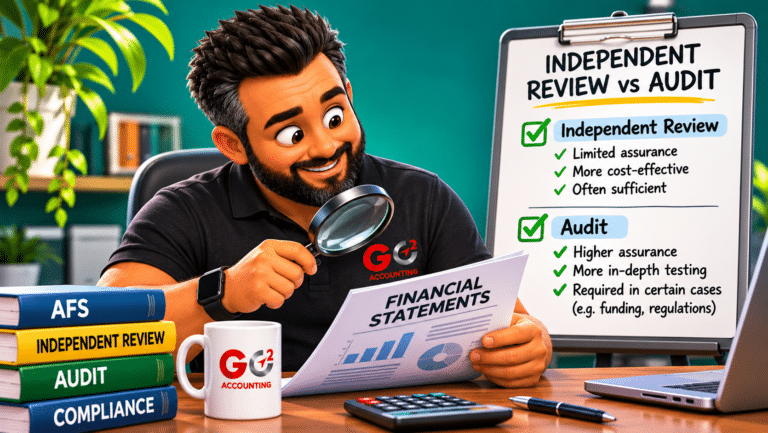
🔍 An independent review is a limited assurance engagement. A qualified reviewer checks whether anything looks materially wrong, mainly through analysis and enquiry. It’s lighter, faster and more affordable.
📋 An audit is a full assurance engagement. A registered auditor digs deep, testing transactions, verifying balances, examining evidence, to express a formal opinion that the financials fairly present the company’s position. It’s thorough, and priced accordingly.
Think of a review as a careful health check, and an audit as a full set of scans and bloodwork. Both useful, but you don’t order the full workup for everyone 💡
🔢 It comes down to your Public Interest Score
South Africa’s Companies Act decides this using something called the Public Interest Score (PIS), an annual score based on four factors:
👥 The average number of employees during the year
💳 Your third-party liability (money owed to outsiders)
💰 Your turnover for the year
👤 The number of individuals with a beneficial interest in the company
Each factor adds points, and the total determines what your company needs 📈
✅ So which do I need?
Here’s the general rule for most companies:
🔴 PIS of 350 or more → Audit required. Full stop (and if your statements are compiled externally, an audit is still required at this level).
🟡 PIS between 100 and 349 → It depends who prepared the financials:
- If your financial statements are compiled internally (by the company itself), you need an audit
- If they’re independently compiled (by an outside professional), an independent review is sufficient
🟢 PIS below 100 → Independent review (and in some cases, where the company is owner-managed, even a review may not be required)
⚠️ Two important caveats: certain companies must always be audited regardless of score, for example if their Memorandum of Incorporation requires it, or if they hold assets in a fiduciary capacity above a threshold. And this is a simplified guide, the exact application has nuances, which is exactly why it’s worth confirming rather than guessing.
❓ Why does “who compiled the financials” matter?
It feels like an odd rule, but there’s logic to it.
If your financials are prepared in-house, there’s no independent eye on them during preparation, so the Act wants the heavier scrutiny of an audit. If an independent accountant compiled them, there’s already an outside professional involved, so a lighter independent review is enough.
In practice, this means having your financials professionally compiled can sometimes lower your assurance requirement from an audit to a review, which can save you real money 💰
❓ Can an independent review save my company money?
Often, yes, if you genuinely qualify for one.
An independent review is meaningfully less expensive than a full audit. For a smaller company that doesn’t legally need an audit, being pushed into one (or assuming you need one) is simply overpaying for assurance you’re not required to have.
The flip side matters too: if you do need an audit and only get a review, you’re non-compliant, and that can surface at exactly the wrong moment, like during a funding application or a sale of the business 😬
❓ Who can perform each one?
🔍 An independent review must be performed by a suitably qualified, independent professional (such as a registered accountant) who wasn’t involved in preparing the financials.
📋 An audit must be performed by a registered auditor.
In both cases, independence is the whole point, the person checking the numbers can’t be the person who made them.
🎯 Not sure which your company needs? Let’s work it out
The honest answer to “review or audit?” is “let’s calculate your Public Interest Score and check the specifics”, because the wrong assumption costs you money or compliance, and sometimes both.
The team at Go2 Accounting can work out your PIS. Tell you exactly what your company is required to have, professionally compile your financial statements, and arrange the review or audit you actually need, no more, no less.
Because the goal isn’t the most assurance money can buy. It’s the right assurance, done properly 😉
