
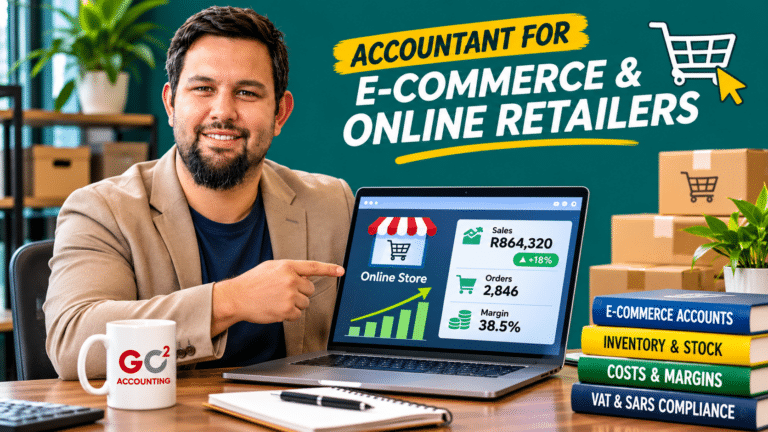
Why Your Books Are Messier Than You Think 🛒
Selling online looks beautifully simple from the outside: list a product, customer clicks buy, money appears 🛒
Then you try to do the books.
Suddenly there are platform fees, payment-gateway deductions, multiple sales channels, refunds, chargebacks, shipping costs, and a VAT picture that’s more tangled than you expected. E-commerce accounting is one of those things that looks easy right up until it very much isn’t.
If you run an online store, here’s what an accountant for e-commerce should actually be untangling for you.
💻 Why online retail is sneakily complicated
A physical shop has a till and a bank deposit. An online store has a dozen moving parts between “customer pays” and “money in your account” 👇
💳 Payment gateways take a cut — the customer pays R500, but PayFast, Peach, Stripe or Yoco deposits less, after fees, and that gap has to be accounted for correctly
🏬 Multiple sales channels — your own site, plus maybe Takealot, Amazon, Instagram, a marketplace, each with its own fees, reports and payout timing
🔄 Refunds and chargebacks — returns and disputes mess with your revenue and need proper handling
📦 Stock across channels — inventory sold in several places at once is easy to over- or under-count
🚚 Shipping and fulfilment costs — often under-tracked, quietly eating margin
🧾 VAT that gets complicated fast — especially once you cross the R2.3m threshold or sell across borders
Each of these is small on its own. Together, they’re why so many online retailers think they’re profitable and can’t quite explain where the cash went 😬
❓ Why can’t I just use my payout figure as my revenue?
Because your payout is not your revenue, and treating it as such is the single most common e-commerce bookkeeping mistake.
When a gateway deposits R9,200 into your account, that might represent R10,000 of sales minus R800 of fees. If you record R9,200 as revenue, you’ve understated both your income and your expenses, which throws off your VAT, your margins and your tax.
A proper e-commerce accountant records the gross sale, the fees and the net payout separately, so your numbers actually reflect reality. Multiply that across hundreds of transactions and channels, and you can see why “I’ll just use the bank figure” quietly corrupts the whole picture 📊
❓ How does cloud accounting help online stores?
This is where e-commerce and modern software are a genuinely great fit.
Platforms like Xero can integrate with your store and payment systems, so sales, fees and payouts flow into your books automatically, reconciled, split out correctly, and up to date. Instead of wrestling spreadsheets of gateway reports at month-end, you get a live, accurate view of:
📈 Your true revenue (gross, not net of fees)
💰 Your real margins after fees, shipping and returns
📦 Your stock position across channels
🧾 Your VAT, calculated on correct figures
For a fast-moving online business, that live visibility isn’t a nice-to-have, it’s how you avoid discovering a problem three months too late ⚡
❓ When does an online store need to register for VAT?
The same rules apply as any business: VAT registration becomes compulsory once your taxable turnover exceeds R2.3 million in a 12-month period, and it’s available voluntarily from R50,000.
But e-commerce adds wrinkles: multiple channels mean your total turnover can creep up faster than you realise, and selling to customers in other countries raises cross-border VAT questions. Many online sellers don’t notice they’ve crossed the threshold until they’re already late, which is an expensive way to find out 😅
A good accountant watches that threshold for you and handles the registration and returns correctly once you’re there.
❓ Does it matter if my accountant understands e-commerce?
It changes the questions they know to ask:
🧾 “Are you recording gross sales and fees separately, or just the payout?”
✅ “What’s your true margin after gateway fees, shipping and returns?”
📦 “Is your stock reconciled across every channel you sell on?”
💰 “Are you tracking turnover against the VAT threshold across all channels?”
💳 “How are refunds and chargebacks being handled in the books?”
A generalist who’s only done bricks-and-mortar businesses won’t think to ask these, and the answers are usually where your real profitability is hiding 💡
🎯 E-commerce-smart accounting for online retailers
Whether you’re running a Shopify store from Pretoria, selling on Takealot, or building a multi-channel online brand, your books should give you a true picture, real revenue, real margins, clean VAT, not a tangle of gateway reports you dread at month-end.
Go2 Accounting works with online and e-commerce businesses using live cloud accounting that integrates with your store and payment systems. From day-to-day bookkeeping and payroll to fully outsourced accounting for online retailers who’d rather focus on selling, we make the numbers behind your store make sense.
Want to actually understand where your online store makes its money? Get in touch for a no-obligation chat.
Because in e-commerce, the store that truly knows its numbers is the one that scales without nasty surprises 😉
